
What Makes the Sodality Different?
Community, Formation, Service, and Devotion

In the American Church today there are many different groups and many different movements for youth and young adults. Youth groups such as LifeTeen, Fraternus, college student Bible studies and men and women’s groups, young adult groups such as Theology on Tap, Young Catholic Professionals, and parish men’s and women’s groups, all provide community and formation to various degrees. Some groups, especially youth groups, also do periodic service. Groups such as the Knights of Columbus focus on service, and mission trips for youth provide both service and community.
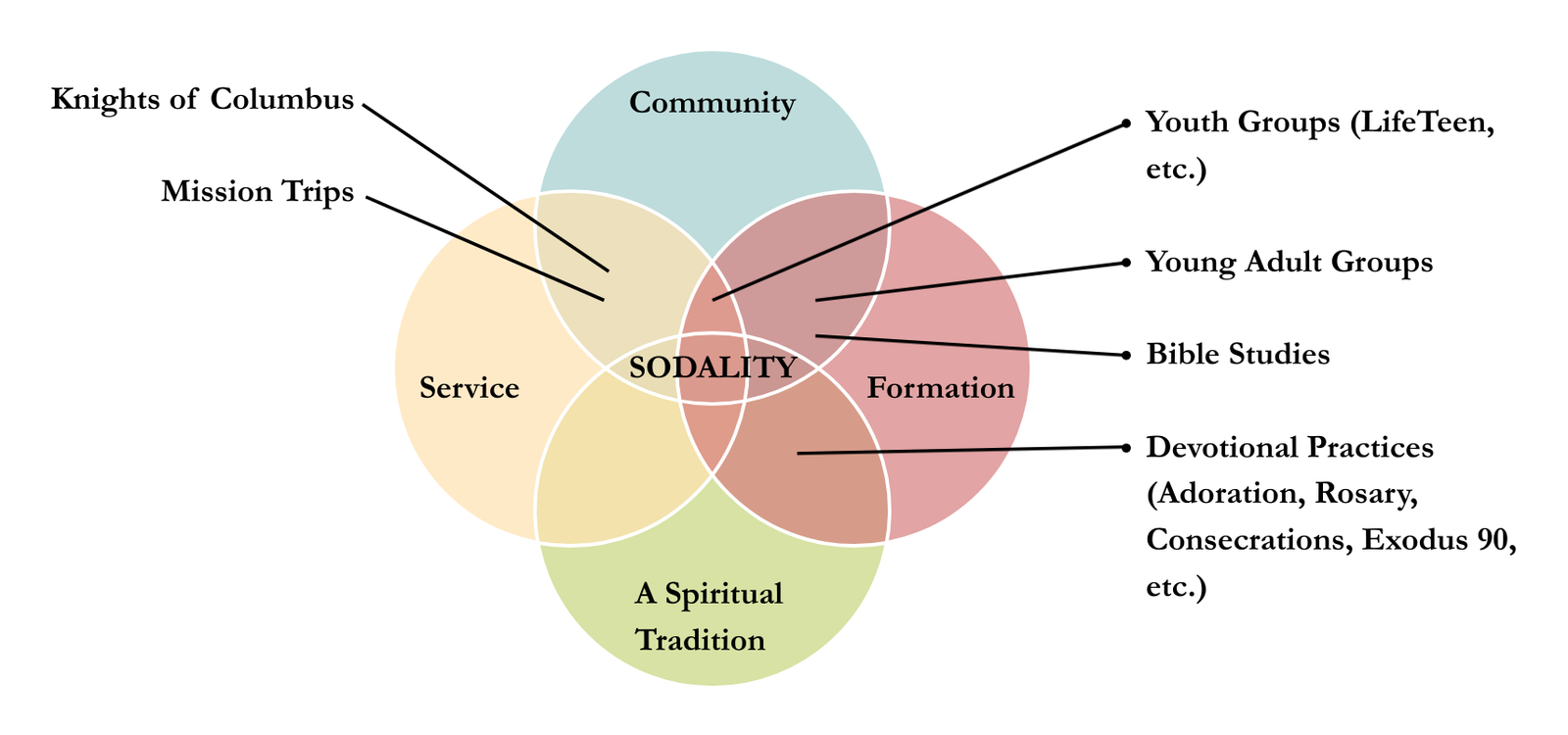
None of the popular youth and young adult organizations in the Church draw from a specific spiritual tradition, such as Benedictine, Franciscan, Carmelite, or Jesuit, but rather tend to take features and themes from each in a piecemeal way. The people in these groups tend to substitute for this lack by taking on spiritual devotions such as Eucharistic Adoration, the rosary, making a consecration to Our Lady, and then ascetical practices such as Exodus 90.
What makes the Sodality different from all of these groups is that it incorporates community, formation, service, and devotion into a coherent way of life ordered within the Ignatian spiritual tradition. Some people might confuse a Sodality as being in the same category as these other youth organizations, but in reality it is in a different category. Like a youth group or a Bible Study, the Sodality provides community and formation, but not in the same way. Like Theology on Tap and YCP it provides speaker events, but not one-off and unconnected. Like service projects, the Sodality commits to the works of mercy, but flowing out of its spirituality and formation. It is the integration of all of these elements that makes the Sodality a unique movement in the Church.
Five Key Distinctions of the Sodality

Beyond the integration of community, formation, service, and devotion, there are five other differences between the Sodality and parish youth and young adult groups.
1. A Higher Level of Commitment
There is a higher level of commitment in a Sodality than in a parish youth or young adult group. There are daily, weekly, and monthly prayer commitments, weekly meetings, monthly service, and an annual retreat that all Sodalists commit to fulfilling.
2. A Specific Spirituality
The Sodality has a specific spirituality drawn from the Spiritual Exercises of St. Ignatius, with a strong Marian dimension. The Jesuit director guarantees the continuity of this spiritual tradition. All of the prayer and activities of the Sodality flow out of, and find their meaning in, the intimate companionship with Christ that is the heart of the Spiritual Exercises.
3. A Structured, Long-Term Formation Program
The Sodality has a structured formation program that is years long and ongoing. Most youth groups have more piecemeal formation that is not sequential. In the Sodality, there is a process of candidacy before someone can become a Sodalist, testing whether a person can fulfill the Sodality commitments. Then, in order to become a full Sodalist, one must make a consecration to Mary. This consecration is not private and interior, it is public and performative, motivating all that the Sodalist does.
4. An Inter-Generational Network
Although the Sodality has age-specific groups, these are interconnected, forming an inter-generational network of communities. One can be in a high school Sodality and then transition into a college Sodality and then an adult Sodality beyond graduation. Whereas one eventually ages out of a youth group or college Bible study, a Sodalist never ages out of the Sodality.
5. A 400-Year Tradition
The Sodality is part of a tradition dating back over four hundred years. This history is a great inspiration and source of strength, for there are many saints who were Sodalists. This history connects individual Sodalities with other communities throughout the world, forming an international movement. This common identity across time and place offers a richness and depth unrivaled by contemporary Catholic groups.
The Sodality of Our Lady, Third Orders, and Lay Ecclesial Movements
The Marian Sodalities can be categorized as a “pious association of the faithful,” similar to many other lay movements. A “pious association of the faithful” is a category used to describe all types of lay groups committed to living their Catholic faith and participating in the mission of the Church. They have a long history in the Church and have exhibited great variety, existing in different forms since the early Church. In the Middle Ages, pious associations of the faithful were given more formal structures, often called confraternities, or lay congregations or societies, with each focusing on a particular spirituality and specific ministerial works. Since the Council of Trent, these associations have grown in number and variety. With the Second Vatican Council, a new impulse of the Holy Spirit has led to new forms of associations, often called today “lay ecclesial movements.”
The Sodality and the Third Orders
Sodalities of Our Lady are most akin to the Third Orders of other religious traditions, such as the Third Order Franciscans. The Third Orders began in a way very similar to the Sodality, as an outpouring of the Holy Spirit upon lay people who were inspired and desired to follow, in their own way, the religious lives of the orders. The Franciscan Third Order, for example, was founded by St. Francis to incorporate all of the lay people who were inspired by the Franciscans and wanted to participate in their life and work. The Sodality too originated as an inspiration to have students formed and sent out in a manner similar to the Jesuits. Many structures of the Third Orders — such as rules, promises, commitments, and hierarchical organization — are similar to those of the Sodality. The differences are that the Sodalities are based on Ignatian spirituality rather than Franciscan or Dominican; they are tied to the Jesuits; they have a strong devotion to Mary; they originated as student groups before adult groups emerged, thus maintaining a focus on youth; and they have a strong apostolic orientation, not merely emphasizing growth in personal holiness.
The Sodality and Lay Ecclesial Movements
The lay ecclesial movements of the post-Vatican II era — such as the Neo-Catechumenal Way, Focolare, and Communion and Liberation — are different from the Sodality and Third Orders in that they are not associated with a religious order and do not draw from a specific spiritual tradition. They are mostly lay-founded and lay-led, which gives their movements a focus on the family and life in the world. They are similar to the Sodality and Third Orders in that they are a community of lay Catholics committed to a common way of life and have an apostolic orientation.
| Area of Focus | Examples of Lay Ecclesial Movements |
| Evangelization & Catechesis | Neocatechumenal Way (formation of adult catechumens), Catholic Charismatic Renewal (renewal of the Holy Spirit in the life of the Church). |
| Family & Marriage | Couples for Christ (family spirituality), Marianist Family Movement (marriage enrichment). |
| Works of mercy & Solidarity | Focolare (community building and solidarity), Lega di Cristo (charitable works). |
| Youth & Education | Communion and Liberation (Education to an encounter with Christ and communion in the Church) Youth 2000 (pilgrimages and youth events). |
| Spiritual Growth & Sanctification of the world | Opus Dei (sanctification of daily work), Schoenstatt (marian devotion and personal sanctity). |
| Evangelization & Catechesis |
| Neocatechumenal Way (formation of adult catechumens), Catholic Charismatic Renewal (renewal of the Holy Spirit in the life of the Church). |
| Family & Marriage |
| Couples for Christ (family spirituality), Marianist Family Movement (marriage enrichment). |
| Works of mercy & Solidarity |
| Focolare (community building and solidarity), Lega di Cristo (charitable works). |
| Youth & Education |
| Communion and Liberation (Education to an encounter with Christ and communion in the Church) Youth 2000 (pilgrimages and youth events). |
| Spiritual Growth & Sanctification of the world |
| Opus Dei (sanctification of daily work), Schoenstatt (marian devotion and personal sanctity). |
Further Reading
- For more on the history of associations of the faithful, see the Catholic Encyclopedia entry.
- For an overview and directory of many ‘associations of the faithful’ formally approved by the Holy See, see the Vatican directory.
- For a history of the Sodality in relation to other confraternities in the Church, see the Catholic Encyclopedia entry: https://www.newadvent.org/cathen/14120a.htm
Take the Next Step
Sodalities are meant to be lived in community. See if there’s a sodality near you and take the next step.