
History of Marian Sodalities
From Ganss, S.J, George. (1975). The Christian Life Communities as Sprung from the Sodalities of Our Lady. Studies in the Spirituality of Jesuits, Vol. VII.2 pp. 45-52
The Founding of the Sodality

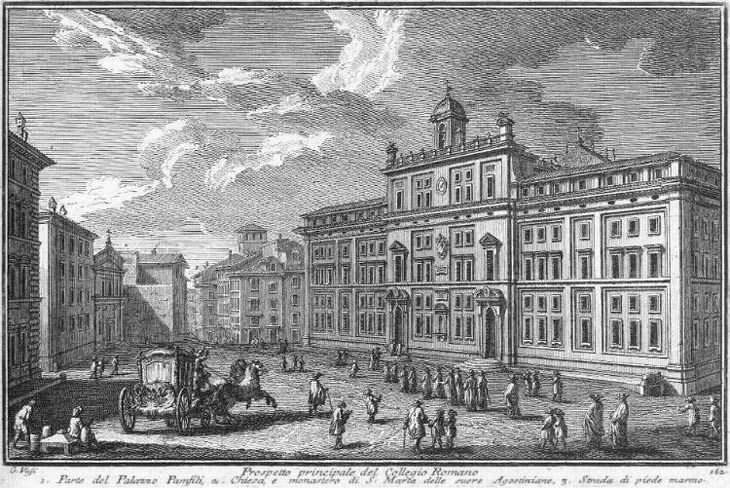
“The Sodality of the Blessed Virgin Mary was founded by a Belgium scholastic, Jan Leunis, in 1563. Eager to foster his students’ spiritual growth, he assembled the more zealous of them in a classroom of the Roman college during after-school hours for prayer and pious exercises, especially in honor of Mary. In 1564 there were seventy members. The group drew up a set of rules. Sodalities modelled on this group soon sprang up in Jesuit colleges throughout Europe, and the original group in Rome became known as the ‘first’ or ‘head’ or ‘central’ congregation or sodality (Primaria Congregatio seu Primariam Sodalitium). As it became too large to meet in one classroom it was divided into three sections: the Prima primaria, the ‘first head or central’ sodality, for the young men over 21, the Secunda primaria for those 14 to 21, and the Tertia primaria for those below 14.
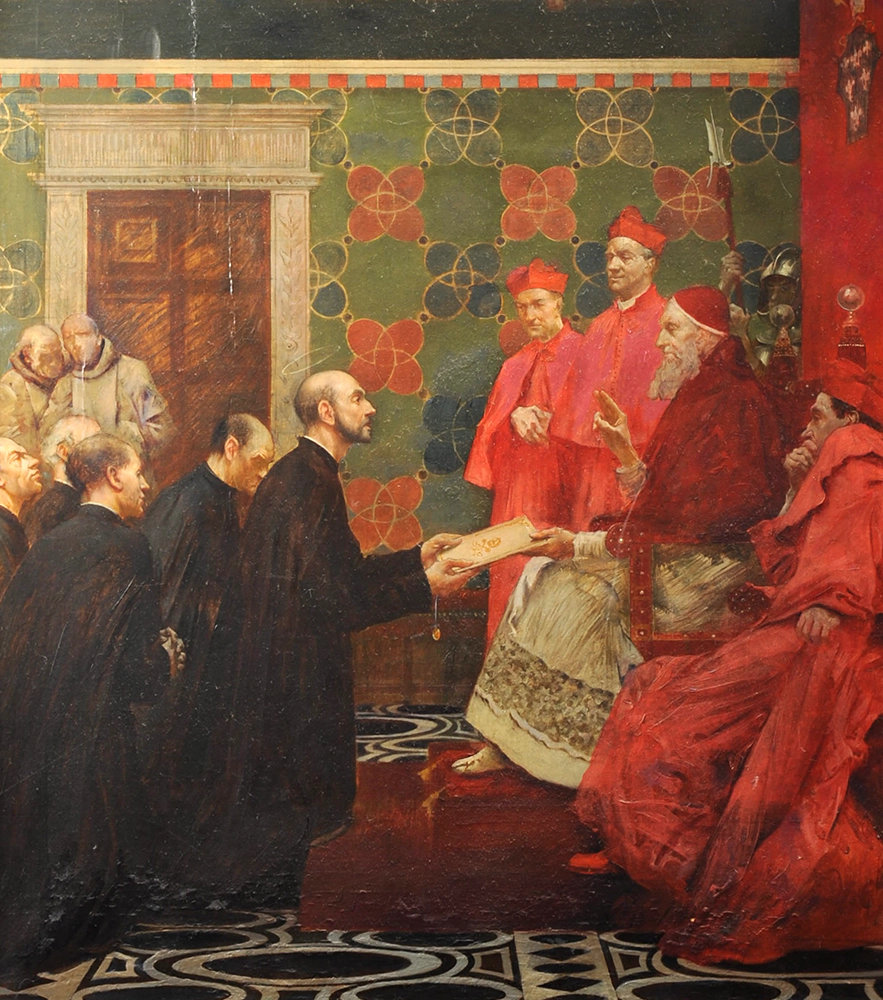
By the bull Omnipotentis Dei of December 5, 1584, Pope Gregory XIII canonically erected the Prima primaria as a congregation or sodality, granted it numerous indulgences, and conferred on the Jesuit general power to erect other similar congregations and affiliate them to the Prima pirmaria [congregation], the ‘First Principal [Congregation].’ In that era the terms congregation sodality, and confraternity were often used as synonyms to designate a body of the faithful, especially non-religious, who aimed to foster Catholic life by means of special exercises, and were governed by an ecclesiastical superior.
Rapid Growth Across the World

Sodalities affiliated to the Prima primaria grew rapidly in number, and soon existed in connection with virtually all Jesuit colleges, churches, and residences in Europe and the Americas. They were groups of persons seriously cultivating their personal interior lives and apostolic activities. By 1580 there were some 30,000 members of affiliated sodalities. In 1586 Pope Sixtus V permitted membership to others than students. In the ‘Golden bull’ of September 27, 1748, Benedict XIV enlarged the privileges and indulgences; and in a brief of September 8, 1751, he granted the Jesuit general authority to affiliate with the Prima primaria any sodality of either sex which was connected with a Jesuit house or church. Between the suppression and restoration of the Society (1773-1814) the sodalities were kept in existence by the pope and zealous pastors. In 1824 Leo XII restored to the Jesuit general his former powers in regard to sodalities. In 1825 the same Pope granted the general faculties to affiliate to the Prima primaria, with the consent of a bishop involved, sodalities which were outside of Jesuit institutions. Thereafter growth of the movement was steady and rapid. In the United States alone, for example, 55 sodalities were affiliated up to 1854, 178 in the decade 1854-1864, and 304 in 1864-1874, 589 in 1874-1884, 1,124 in 1884-1894,
1,368 in 1894-1904, 1758 in 1904-1914, 2,357 in 1914-1926. In the world at large, some 35,000 new sodalities were affiliated to the Prima primaria within fifty years after the definition of the Immaculate Conception in 1854. In 1963, about 85,000 sodalities in more than 1,300 dioceses were on the list of affiliates.
Organizing the Sodality: The Common Rules
The multiplication of sodalities after 1563 led many to desire uniform directives and norms, which would, moreover, facilitate the granting of further indulgences and other privileges by the Holy See. Early in his generalate Claudio Aquaviva took steps in this direction. Then in 1578 he promulgated the Regulae communes, rules applying or ‘common’ to all the sodalities. In eight chapters they treated such matters as the nature of the sodalities, their purpose, exercises of piety, manner and criteria of admission, meetings, officers and their duties, and government. These rules remained in force until the suppression of the Society in 1773. After the restoration, they were revised and promulgated anew in 1855 by Father General Beckx for Jesuit and non-Jesuit sodalities. Some of the statutes of 1587 were dropped and others added; but about 115 are much the same in both documents.
Sodalities flourished in Spain in the latter nineteenth century and thus developed rules of their own, composed largely from those of 1587 and 1855. In 1909 Father General Wernz assembled fourteen Jesuit experts from many countries, who examined and revised all preceding rules and then drew up a new set which he promulgated on December 8, 1910. They are written in the form of a legal code with an improved logical order, and are more clear and precise than any which preceded them.
These Common Rules of 1910 comprise the set familiar to American sodalists since then, and especially to Jesuits who were engaged in sodality work in Jesuit schools between 1930 and 1965. They will recall many memories through citation here of a few of these rules which reveal much of the sodalities’ spirit.
1. Sodalities of Our Lady are religious associations approved by the Holy See. They organize Catholics under Our Lady’s name and cultivate in them a deep devotedness, reverence, and filial love for the Blessed Virgin Mary. Under the patronage of the Mother of God, Sodalities of Our Lady aim at making their members outstanding Catholics who give themselves wholeheartedly to sanctifying themselves in their own states of life and strenuously endeavor, as far as their social conditions permit, to save and sanctify others and to defend the Church of Jesus Christ against the attacks of its enemies.
34. Sodalists shall be very diligent in performing those religious exercises which are particularly necessary for a fervent life. The daily exercises are the following:
- Every morning, on rising, Sodalists shall make acts of faith, hope, and charity, give thanks to the Divine Majesty for benefits received, offer to God their labors of the day, make an intention to gain all possible indulgences that day, and say at least three Hail Mary’s in honor of the Blessed Virgin Mary.
- They shall set aside and spend at least a quarter of an hour in mental prayer.
- If possible, they are to participate in the Sacrifice of the Mass.
- They shall recite the Rosary or an office of the Blessed Virgin Mary.
- In the evening, before retiring, they are to examine their conscience carefully and make a fervent act of contrition for all the sins of their life and especially for any committed that day.
Great variations of practice in the manner of observing the Common Rules were much to be expected in four centuries of history with such vast numbers of sodalities and sodalists. Two poles often in tension were the number of sodalists and the quality of their spiritual practice. Often when either pole waxed in attention received, the other waned. During the last few decades of the nineteenth century and the first few of the twentieth, the Church was stressing monthly corporate Mass and communion for the laity. Sodalities were widely used to promote this movement, especially in the United States; and often the corporate Mass and communion sufficed in practice as the criteria for membership. This was something different from the daily exercises fostered in the rules of 1587 and 1910. But the Holy Spirit works in and through large numbers too; and immense good was done through these widespread sodalities.
The Sodality in America: Fr. Daniel Lord
To make the new rules of 1910 more effective, Father Wernz in 1913 asked the Jesuits to inaugurate sodality magazines in their various countries. Thus the Queen’s Work was established in St. Louis with Father Edward F. Garasché as editor. In 1925 Fr. Daniel A. Lord was assigned to this post, in the hope that he could use his remarkable talents to impart a new life to the sodality movement throughout the nation. Unusually alerty to the mentality and spiritual needs of American youth and to social issues, he achieved remarkable success. He presented the sodality as a challenge and a way of life aimed to bring oneself and one’s neighbor to God. In 1929 he organized the National Parish Sodality Advisory Board, which became a step toward national sodality unity. He started a series of pamphlets and other publications, of which the total sales were over 25,000,000 by 1963. In 1931, in response to Pius XI’s call to Catholic Action, he founded the travelling Summer Schools of Catholic Action, which by 1963 had registered almost 300,000 participants.
Renewal and the Push for Quality
All this provided in the United States a widespread fertile soil in which the seeds of a new movement toward quality could take root. A great impetus toward such a movement came in Bis saeculari, the apostolic constitution on the sodalities issued by Pius XII on September 27, 1948. It praised and urged anew the Common Rules of 1910. In 1953 Pius XII also juridically established the World Federation of Sodalities, to secure their more effective cooperation in the lay apostolate throughout the world. A Jesuit experienced in sodality work, Father Louis A. Paulussen, was named Director of this World Federation, which now had its secretariat at Borgo Santo Spirito 8, Rome. These encouraging efforts of the Holy Father received hearty support from Father General Janssens. In reponse to directives from their general, many Jesuits threw themselves wholeheartedly from 1948 to 1965 into efforts to conduct sodalities according to Bis saeculariand the Common Rules of 1910.
Challenges From Within
They achieved some notable success. But they encountered discouraging difficulties, too, which grew as the years passed by. More and more during the 1950s many who had worked zealously and sincerely to promote sodalities according to Bis saeculari made remarks along the following lines. The Common Rules seem to be rules of a religious institute, not well adapted to lay life in our day. They urge practices which some sodalists take up sincerely for a few months or occasionally years, but then drop under the pressures of daily living. We profess to be training young persons during high school or university to a way of living which is to be continued for the rest of their lives. But it is a way of living which usually requires that they ‘pray together, work together, and play together’; and most of them will live after graduation in places where no adult sodality exists. Even in cities where many high school and university sodalities produced well-trained sodalists, a central adult sodality for them after graduation met insuperable opposition. Pastors feared that any such group would draw these zealous young persons away from the activities of their own parishes.
Difficulties arose, too, from the word ‘rules.’ In countries where the Latin tradition of law was part of the culture, the word was subconsciously interpreted to mean a directive enshrining an ideal, something encouraging even if only partly attainable in practice. But in countries with the Anglo-Saxon legal tradition, many directors interpreted ‘rule’ as a precept to be fulfilled literally under penalty of exclusion or expulsion; and this was discouraging to those who found themselves unable to observe a rule in all its details. After a year or two many sodalists, directors, and sodalities gave up. The National Federation of Sodalities began a revision of the Common Rules in 1959 but postponed it to await possible guidance from the forthcoming Vatican Council II.
The Birth of Christian Life Communities
Then came Vatican Council II, with its decrees which urged that increased initiative and responsibility be given to the laity in the apostolate of the Church (for example, the Church, nos. 31, 33; the Church Today, nos. 36, 43; the Apostolate of the Laity, nos. 3, 9, 71). There came also Jesuit General Congregation XXXI, 1965-1966. Some delegates initiated efforts and preliminary drafts toward reaffirming but renewing the Sodalities (Congregationes Marianae), more or less according to the Rules of 1910, as an important Jesuit ministry. Although no separate document on the Sodalities survived the committee work, mention of them was made in two other documents which reflected the spirit of the Council on giving more initiative to the Laity.
These pronouncements of Vatican II and General Congregation XXXI found attentive disciples in the officers, staff, and members of the World Federation of Sodalities, who soon devised worldwide consultations to implement them. Back in 1587, 1855, and 1910 ecclesiastics had composed the Rules, obtained papal approval of them, and handed them down to the directors and lay members for execution. Why not try now, with this guidance from Vatican II and General Congregation XXXI, to reverse this direction? The Roman office of the World Federation, and also the secretariats of many national federations such as the Association Vie Chrétienne in Paris or the National Federation of Sodalities in St. Louis, initiated many meetings to have the lay sodalists, with counsel from their ecclesiastical moderators, work out directives which they found to be better adjusted to their lay circumstances, have them approved, after sufficient elaboration, by the Holy Father, and thus gain better cooperation from all the members in the task of implementation. The movement was to become truly lay with autonomy, but the Society would give it help and inspiration.
Hence from 1966 onward these sodalists held many meetings, in a spirit of communal discernment drawn from the Ignatian Exercises, toward renewing the spirit and structure of the Sodalities. The participants tried to keep the ancient spirit and tradition but make them more effective in the post-conciliar world. A draft of a new set of directives was approved in an international meeting of the World Federation in Rome, October 19-21, 1967, and submitted shortly later to the Holy See for approval. In this draft the former title, Sodalities of Our Lady (Congregationes Marianae) was changed to Christian Life Communities (Communitates Vitae Christianae), and the name Common Rules (Regulae communes) to General Principles and Statutes of the Christian Life Communities (Principia generalia et Statuta). The World Federation of Sodalities became the World Federation of Christian Life Communities.
Addendum To Ganss’ History of the Sodalities
The History of Sodalities and CLCs Since The New Configuration Of 1968
Since its founding in 1968, the World Federation of Communities of Christian Life has grown and spread throughout the world. It is an official lay association of the faithful that, although juridically independent from the Society of Jesus, with its own leaders and governance, still enjoys a close relationship with the Society. The Superior General of the Society of Jesus is the official ecclesiastical assistant to CLC, with many national and local CLC organizations having Jesuit ecclesiastical assistants as well. As a lay led organization, CLCs have developed their own distinguished history and identity, boasting over 25,000 members in sixty countries. CLC groups are governed by their General Principles and are organized into National Associations, which meet in General Assembly every five years.
The Sodalities have had a different trajectory. The 1968 letter of Fr. Arrupe dissolved their aggregation to the Prima Primaria. For a time some of them were associated under the World Federation of Communities of Christian Life, while others came to exist as independent associations of the lay faithful. As the CLCs continued to develop their new way of life, the student Sodalities at Jesuit institutions received less and less attention, most of which slowly died away or became dormant. The Sodalities that continued to thrive in an unbroken line through all of the changes, such as the Agrupación Catolica Universitaria in Miami and the Sodality in Dublin, eventually became fully independent from the CLCs and maintained a different relationship to the Society of Jesus. The Sodalities that exist today are separate from the CLCs and maintain their own traditions and practices.
Therefore, one can say that today the Sodalities and the CLCs exist as two distinct movements in the Church, with different visions and practice, yet sharing in a common spiritual heritage that goes back to the Prima Primaria of 1563, as two branches from a common trunk.
Take the Next Step
Sodalities are meant to be lived in community. See if there’s a sodality near you and take the next step.